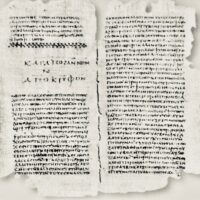
The Nag Hammadi Library
What it is
A collection of 13 ancient codices (bound books, not scrolls) discovered in 1945 near Nag Hammadi, Egypt. They contain 52 texts, mostly written in Coptic, translated from earlier Greek originals.

Date
• Manuscripts copied around the 4th century CE
• Many texts likely composed in the 2nd–3rd centuries CE
Why it matters
These writings transformed modern understanding of early Christianity and Gnosticism, revealing beliefs and traditions that existed alongside (and often competed with) what later became orthodox Christianity.
Famous texts in the collection
• Gospel of Thomas – sayings attributed to Jesus, without narrative
• Gospel of Philip – symbolic teachings about sacraments and knowledge
• Gospel of Truth – a theological meditation often linked to Valentinian Gnosticism
• Apocryphon of John – a detailed Gnostic creation story
• Hypostasis of the Archons – mythic explanation of cosmic rulers
Core themes
• Gnosis: salvation through inner knowledge
• A sharp divide between the material world and the spiritual realm
• The idea of a lesser creator (Demiurge) distinct from the ultimate divine source
• Emphasis on personal spiritual awakening
How they were found
Local farmers uncovered a sealed jar containing the books. The manuscripts eventually made their way to museums and scholars, leading to decades of translation and study.

The Gospel of Thomas
What it is
The Gospel of Thomas is a collection of 114 sayings (logia) attributed to Jesus. Unlike the New Testament gospels, it has no narrative—no birth story, miracles, crucifixion, or resurrection. It’s purely sayings and teachings.
Discovery
• Found in 1945 at Nag Hammadi, Egypt
• Preserved in Coptic (Codex II)
• Earlier Greek fragments (1st–2nd century) were found at Oxyrhynchus, suggesting it’s quite early
Date
Most scholars date its composition to c. 50–140 CE
(Some argue parts may be as early as, or earlier than, the Synoptic Gospels.)

Core Themes
1. Inner Knowledge (Gnosis)
Salvation comes through self-knowledge and insight, not faith in events.
“If you bring forth what is within you, what you bring forth will save you.” (Logion 70)
2. The Kingdom Is Present
The “Kingdom of God” is not future or external.
“The kingdom is inside you and it is outside you.” (Logion 3)
3. Hidden Meaning
Jesus speaks in riddles meant to be interpreted, not merely believed.
“Whoever finds the interpretation of these sayings will not experience death.” (Logion 1)
4. Radical Non-Dualism
Opposites (male/female, inner/outer) must be unified.
“When you make the two one…” (Logion 22)
How It Compares to the New Testament
#Gospel of Thomas #Canonical Gospels
#Sayings only #Stories + sayings
#No crucifixion/resurrection #Central to theology
#Salvation via knowledge #Salvation via faith
#Mystical, inward #Historical + theological
#No church structure #Supports emerging orthodoxy
Some sayings closely parallel Matthew and Luke, while others are completely unique and mystical.
